
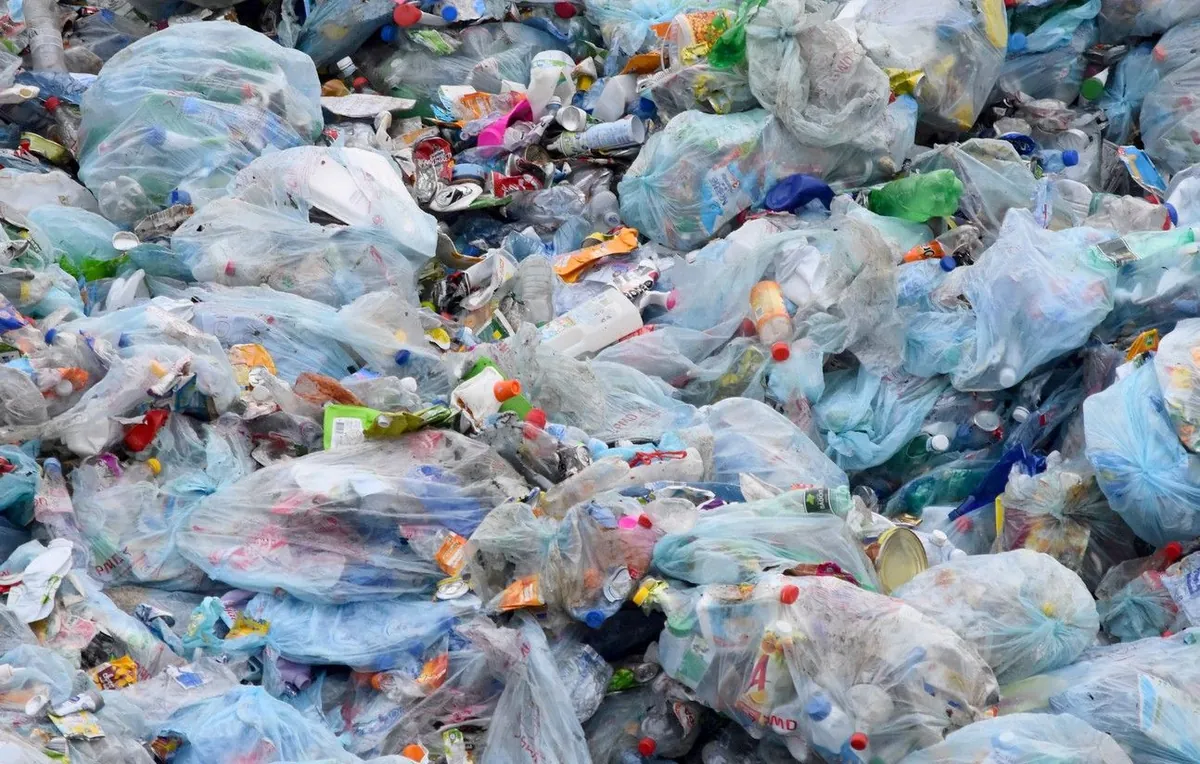
In 2019 the world produced 353 million metric tons of plastic waste. 9% of it was recycled; the rest was landfilled, burned or lost to the environment. We write from Tunisia, on the shore of a sea that takes in hundreds of thousands of tons of plastic every year, and we are opening this journal with one conviction: recycled plastic is a material in its own right, and we intend to show it with numbers and with objects.
Made to last, used for minutes
Pick up a bottle cap. It is light and watertight. It will not rust and it will not rot. It does its job for as long as it takes to drink a liter of water. After that it can sit in a ditch or on a beach for decades.
That is the paradox of plastic. The qualities that make it a menace in nature are the ones we look for in furniture: resistance to water, to knocks and to time. Global production doubled between 2000 and 2019 to reach 460 million metric tons a year, according to the OECD. A large share of that volume goes into packaging that is thrown away almost at once.
We are not defending throwaway plastic. We think a material this durable deserves durable uses.
What the numbers say, seen from the Mediterranean
The Mediterranean is an almost closed sea: most of the plastic that enters it settles in its sediments. Five figures set out the problem, from the world down to Tunisia.
| Scale | What we know | Source |
|---|---|---|
| World | 9% of plastic waste is recycled | OECD, 2019 data |
| World | Recycled plastic is equal to 6% of total plastics production | OECD, 2019 data |
| Mediterranean | 229,000 metric tons of plastic leak into the sea each year, 94% of it from mismanaged waste | IUCN, 2020 |
| Tunisia | About 188,000 metric tons of plastic waste a year | Draft law reported by La Presse de Tunisie, 2026 |
| Tunisia | The official recycling rate is no higher than 4% | Greenpeace MENA, reported by TAP, 2026 |
The third line matters most to us. Most of the plastic in the sea comes from waste that was never collected or treated on land. The cause is a system that fails, and a system can be repaired.
In Tunisia that system rests largely on the barbéchas. These informal waste pickers recover about 80% of the country's recyclable waste, with no legal status and no social protection, according to the same Greenpeace MENA report. The material is there, and so are the people who know how to sort it. In our view, what is missing most is outlets that give value to what they collect.
Circular economy: our three convictions
The material has value. Most everyday plastics are thermoplastics: they can be melted and given a new shape. Sorted by family and cleaned, they become a raw material again. That is where the circular economy starts: what has served once serves again.
Design decides what happens next. An object you keep for twenty years is waste avoided for twenty years. That is settled at the drawing board: one family of plastic per part, joints that come apart, shapes people want to keep.
Proof before promise. Printing "recycled" on a label is no longer enough. Where the plastic came from, what the piece is made of, what happens to it at the end of its life: this information should travel with the object. That is what traceability is for, and this journal gives it a section of its own.
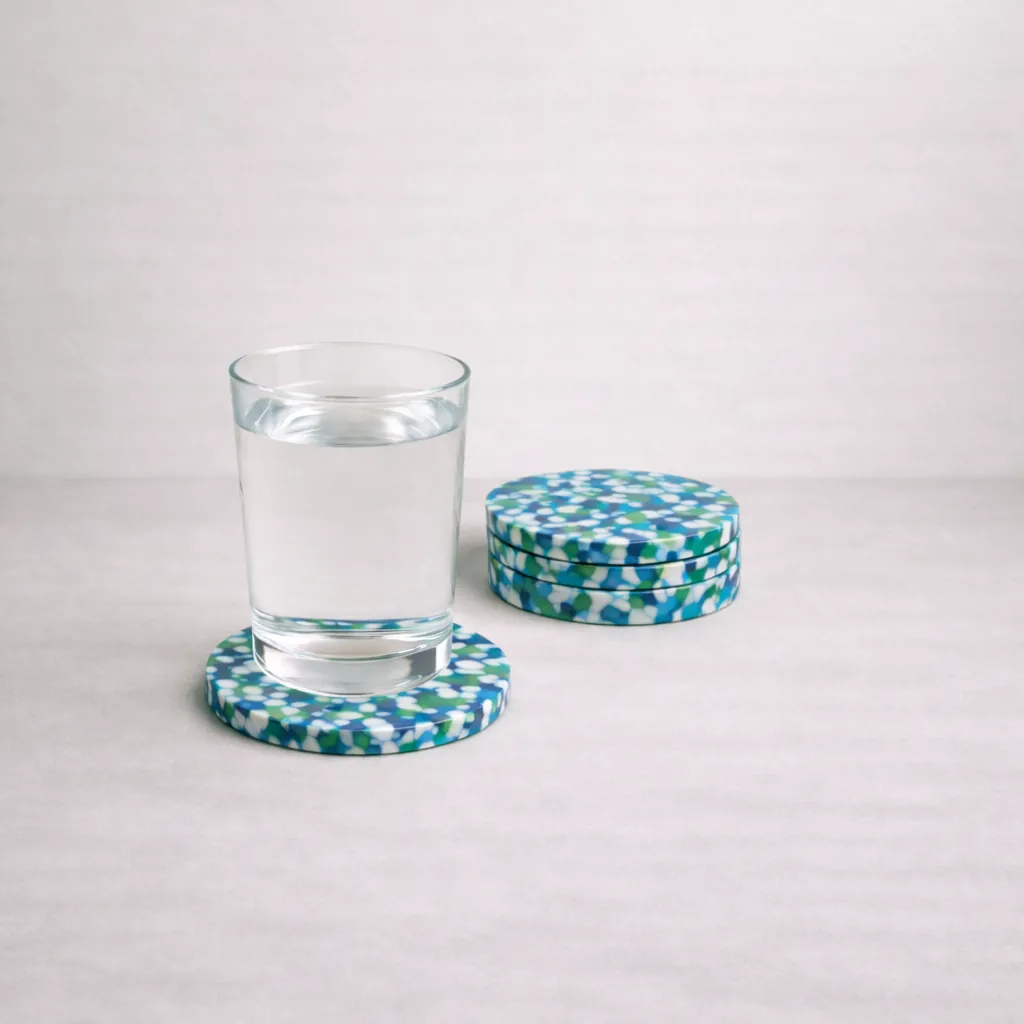
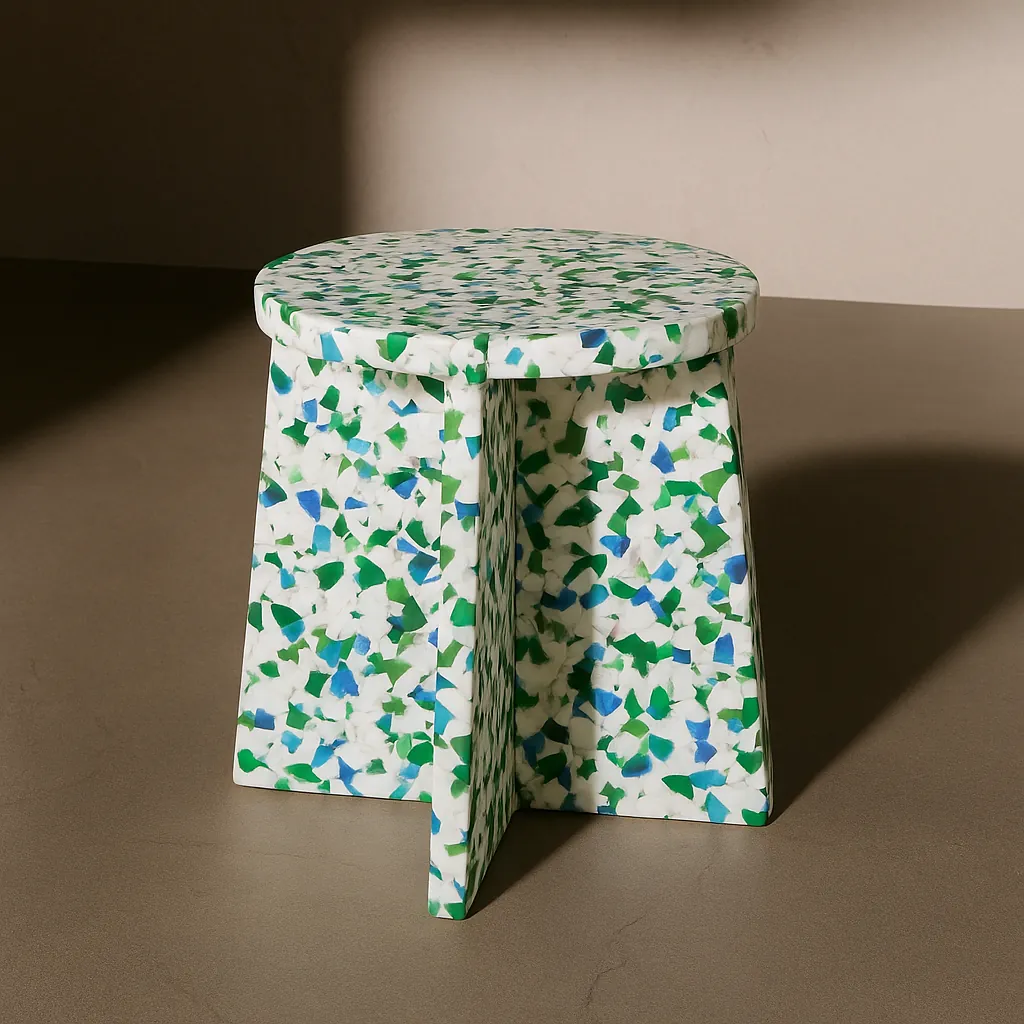
At Plaskito we are starting with what fits in your hands: decorative objects and small furniture. It is in use, when someone sits on it or stacks books on it, that the material is judged. Our plastic comes from Tunisia: industrial waste and post-consumer waste. We work with two families, high-density polyethylene (HDPE) and low-density polyethylene (LDPE). A coaster weighs 50 g, the equivalent of 10 bottle caps. A stool weighs 3.5 kg, the equivalent of 700 bottle caps.
What recycling does not fix
Recycling is not enough, and we would rather say so in the first article.
- Recycling does not reduce production. The first lever is still to make and use less throwaway plastic.
- The material tires. Each time it is remelted, the polymer chains shorten and its properties drop. A piece cannot be recycled forever.
- A table is not a bottle. Turning bottle caps into furniture takes the material out of its original loop. It only makes sense if the furniture lasts a long time and is taken back at the end of its life.
- Not all plastics can be recycled. Blends, multilayer packaging and some additives make remelting difficult or impossible.
- A global framework is still missing. The Geneva talks on a treaty against plastic pollution ended in August 2025 without agreement, as the RIFS institute in Potsdam notes.
Frequently asked questions
Is recycled plastic as strong as new plastic?
It depends on the family of plastic, the quality of the sorting and the process. Each remelting degrades the material a little. That is why the choice of feedstock, the thickness and the design of a piece matter as much as the material itself.
Can plastic be recycled forever?
No. Mechanical recycling gradually damages the polymer. Hence the case for locking the material into objects that last, then taking them back at the end of their life.
Where does the plastic in the Mediterranean come from?
According to the IUCN, 94% comes from waste mismanaged on land. The rest is primary microplastics, chiefly tire dust and textile fibers.
Sources
- OECD, press release on the Global Plastics Outlook, February 22, 2022: production, waste, recycling rate.
- IUCN, Mare Plasticum: The Mediterranean, October 27, 2020: plastic flows into the Mediterranean.
- La Presse de Tunisie, July 5, 2026: tonnage of plastic waste in Tunisia.
- Tunis Afrique Presse, via AllAfrica, January 15, 2026: Greenpeace MENA report on local solutions to plastic pollution.
- RIFS Potsdam, February 3, 2026: state of the global treaty negotiations.